Greetings and Salutations,
After spending more than a month in Antigua, Maura and I felt the need to move on to the next city, make some new contacts and expand our base of organizations. Deciding that Xela (Quetzaltenango for short) was our next step, we departed the day our rent ran out on our Antigua apartment and passed a few days in Panajachel before arriving at our new base. (more on Xela later...)
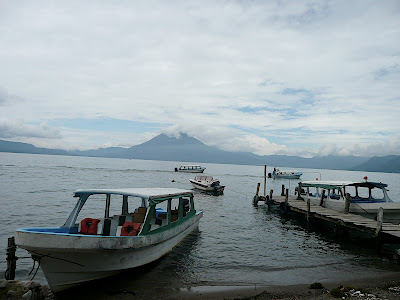
Overtaken by foreigners in the seventies, Panajachel is a tourist-run, resort-like city resting on the beautiful Lago de Atitlan. The lake is sandwiched among three awe-inspiring volcanoes and the surface of the water is at an altitude of about 7,000 ft (that's higher than Denver in case you were wondering :) While it feels like you could skip a stone clear across the deep blue water, the lake is about 15 miles across and it takes more than 30 minutes by water taxi to get from one end to the other. Atitlan's remote sleepy villages cling to the steep slopes of the bowl-like mountains that encompass the lake.
Sitting on the shore at night and gazing from one tiny cluster of houses to the next, one wonders how/if the villagers ever get to the outside world, as they could not be more remote if they were tiny islands in the middle of the Pacific. Despite this illusion of isolation, each day hoards of Mayan women (garbed in their traditional traje) walk the streets of these newly formed Gringotenangos and pull beautiful handmade crafts from baskets balanced atop their heads for hundreds of tourists to turn their noses up at while eating their desayunos tipicos.
While visiting the now hippie-dominated waterfront village of San Pedro, we saw the remnants of a life before “Lonely Planet” guidebooks directed flocks of tourists to secret adventures and Nalgene water bottles became a permanent accessory to the world traveler. After a short hike to a cliff perched over the coast below, we watched the local Tzutzujil population and the lake come to life.
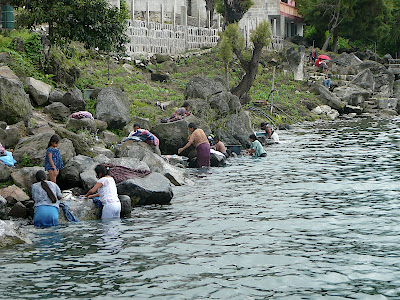
The shore was filled with children swimming, men fishing, several people washing away the dirt of the fields with bars of Irish Springs, and half-a-dozen local mujeres standing waste high in the water doing the morning laundry. Roughly 15 stone washboards were somehow secured in the water for this purpose, and it was quite an experience to pretend for a moment that our presence was not an intrusion but rather a window into a culture whose daily lives have revolved around this lake for as many years as the lake is meters high. The only reminder of the time in which we now live was to the see the Doritos bags and Coke bottles rattling against the rocky shore.
In short, Atitlan is a beautiful place, ruined only by the tourists (just like us :) that pollute the water and the local culture with their presence. It is easy to forget that the presence of tourism, while corrupting an ancient way of life, brings many positive side-effects, it being the main source of income in the region.
Reconciling the tradeoff between cultural and environmental preservation with finding opportunities for development in the face of abject poverty is an issue that has given us much to ponder. While the road to hell may be paved with good intentions, it seems plausible that an educated, cautious optimism and a humble approach can lead to those same good intentions leading to more desirable outcomes. What remains to be seen is how far the aforementioned tradeoff reaches, and what sacrifices must be made to achieve that greater purpose. As with most things in life, tradeoffs are unavoidable and any action results in both positive and negative side-effects. Although--not to downplay the severity of the irretrievable losses that change brings with it--a negative result does not imply a balance cannot be found, or that one should stop trying to find it, as life and development is about striving to find that elusive equilibrium which does more good than harm...(can you tell I'm an Economics student yet? :)
Estoy Pensando,
Justin

4 comments:
"The road to hell is paved with good intentions..."
I just had a really long, intense discussion about this with Christine Wilson, as it is something that I have struggled with during my travels and experiences.
I found what you wrote very interesting, and I can't help but hope you are right.
The only question I have, though, is about development and nonprofit work in general:
What right do we have, as privilaged Americans, to tell the people of another country that they are underdeveloped and in need of help? Isn't it possible that they are happy with their way of life, even though it isn't as glamorous as we imagine life should be? Didn't we, as Americans, live in a similar way, with limited resources and opportunities at one time?
It's two different ways of life, but who's to say that one way is better than the other?
--Sarah
Why Bother?
I am writing this in response to a comment left by Sarah on my last entry. I have copied her comments below.
First off I would like to thank Sarah for her comments. This speaks to something that I have given a great deal of thought (in fact it is closely related to the topic of my thesis :). Keeping in mind that any answer to this type of question is inherently based in ideology and not fact, I will endeavor to offer my (somewhat brief) response to this issue while acknowledging that other's may disagree. I hope that this spurs a discussion and that you will leave your own impressions...
Even though in reality there are plenty of examples of inefficiencies, inadequacies and just plain ineptness within the development community, on the whole I believe the world is better off with the current system in place than it would be otherwise. However, in my mind, this discussion boils down to an academic question. Namely, whether or not economic development is possible.
My basic assumption here is that poverty and human suffering are real and unavoidable. Furthermore, I assume that the magnitude of that suffering is not fixed, and just as the world can be worse off than it currently is, it could also be better. Whether or not you personally agree with these assumptions, there are countless good people devoting their lives to causes that operate under one assumption: it doesn't have to be this way. Furthermore, we are all trying to achieve one goal: making this world (even if its just our small piece of it) a little better.
Does the tide rise all ships or is the road to hell paved with good intentions? While it is true that occasionally good intentions have unintended negative consequences, it is also often true that good begets more good. To argue that development efforts do nothing more than “interfere” with developing nations, simply because there are cases where more harm has been done than good, is essentially to throw the baby out with the bath water.
If the world associates arrogance and ethnocentrism with the Western developer, let us remember that those traits can (and will) be altered if they are shown to be sufficiently ineffective. Furthermore, these generalities do not imply the development system itself is flawed. Those who think they posses all the answers to the world's problems need not be in the business long before realizing that development is hard, and that which looks simple in theory is never simple in its application. Every idealist and do-gooder should remember that if there was an easy way to change the world, it probably already would have been done.
For example, one would think that given the current technological age in which we find ourselves, there would be a website like Many Efforts, One Goal already in use. The idea itself is not very complicated, but we came down not fully understanding how difficult it would be to enact something of this magnitude. We approach this project with passion for our cause, energy in our work and the belief that we can actually help people. However, in our own experiences, we have come to realize that more often than not you will take more from a situation than you bring to it. The developer has to be humble--flexible to cultural norms and customs, working within the context of specific communities, as opposed to within an ideological framework predetermined by a western education and lifestyle. Otherwise, development efforts may run the risk of alienating cultures, and doing more harm than good.
I said in the beginning that this boiled down to whether or not economic development is possible. If it is possible, and the world can be better off tomorrow than it is today, then we have both a vested self-interest and a moral imperative in making every effort to sniff out human suffering and alleviate it. However, if instead the tradeoffs mentioned in the previous post are a zero-sum game (in that any effort to help one person is just going to hurt another by an equal or greater amount), then the developer's place in the world is not as clear.
In this situation it may no longer be in one's self-interest to help his neighbor, because he could be unintentionally hurting himself or another neighbor at the same time. However, isn't there still a moral imperative in this case? If one considers the responsibility of the haves to look out for the have-nots, then isn't there still a place for the developer in this zero-sum game--particularly if the act of “having” caused the have-nots to be worse off than they would have been otherwise?
Many people claim that the world's poor are made poorer because of the imbalanced game created and controlled by the West. If one's fortune has directly or indirectly caused another's misfortune, then perhaps the fortunate are morally obliged to level the playing field and assist the unfortunate at a cost to themselves (See Thomas Pogge 2005 for a more detailed argument). Yet, even if one's fortune has not directly caused another's misfortune, but the fortunate's respective position is a product of chance and birth as opposed to ability and effort, there can still be a moral imperative justification for the developer's place in the world on the grounds of increasing global equity (as opposed to efficiency).
Thus, the only situation where one can definitively argue that the developer has no place in the world is if human progress and economic development are impossible, and if the developer is incapable of eliciting gains in either efficiency or equity. In other words, the developer may be argued obsolete if and only if wealth and utility can neither be generated nor redistributed in a just manner.
Thus, within my ideology, I find comfort in the conclusion that even the inexperienced, yet well-intentioned developer can (and actively does) change the world, so long as he or she has a habit of learning from past mistakes. Debate, collaboration and open communication with one's counterparts are essential to becoming a responsible member of the development community, and one must actively learn from the past in order to avoid reinventing the wheel and perpetuating those aforementioned negative side-effects.
In summary, I would say that I would rather have a well-intentioned fool in charge of saving the world than a mal-humored critic. It is better to be wrong than apathetic.
~Justin
How do you define human suffering? Is it associated with poverty? Unhappiness? Illness? Death? Isn't it possible that the so called impoverished communities themselves, don't necessarily consider themselves in a state of suffering? If so, is "economic development" necessary?
Maybe economic development isn't the answer. We, as Americans, live and strive off of capitalistic ideaology. But is a capitalistic society the best route for developing nations? Is it our right or moral obligation to force capitalism and development onto the countries that we percieve as suffering?
~Sarah
When I say Efforts, you say Goal.
Efforts!
Post a Comment