Greetings and Salutations,
After spending more than a month in Antigua, Maura and I felt the need to move on to the next city, make some new contacts and expand our base of organizations. Deciding that Xela (Quetzaltenango for short) was our next step, we departed the day our rent ran out on our Antigua apartment and passed a few days in Panajachel before arriving at our new base. (more on Xela later...)
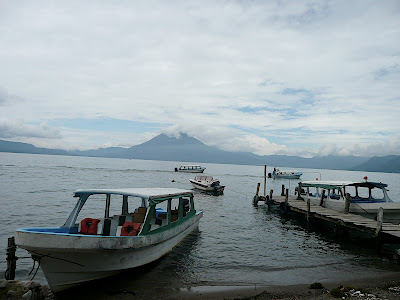
Overtaken by foreigners in the seventies, Panajachel is a tourist-run, resort-like city resting on the beautiful Lago de Atitlan. The lake is sandwiched among three awe-inspiring volcanoes and the surface of the water is at an altitude of about 7,000 ft (that's higher than Denver in case you were wondering :) While it feels like you could skip a stone clear across the deep blue water, the lake is about 15 miles across and it takes more than 30 minutes by water taxi to get from one end to the other. Atitlan's remote sleepy villages cling to the steep slopes of the bowl-like mountains that encompass the lake.
Sitting on the shore at night and gazing from one tiny cluster of houses to the next, one wonders how/if the villagers ever get to the outside world, as they could not be more remote if they were tiny islands in the middle of the Pacific. Despite this illusion of isolation, each day hoards of Mayan women (garbed in their traditional traje) walk the streets of these newly formed Gringotenangos and pull beautiful handmade crafts from baskets balanced atop their heads for hundreds of tourists to turn their noses up at while eating their desayunos tipicos.
While visiting the now hippie-dominated waterfront village of San Pedro, we saw the remnants of a life before “Lonely Planet” guidebooks directed flocks of tourists to secret adventures and Nalgene water bottles became a permanent accessory to the world traveler. After a short hike to a cliff perched over the coast below, we watched the local Tzutzujil population and the lake come to life.
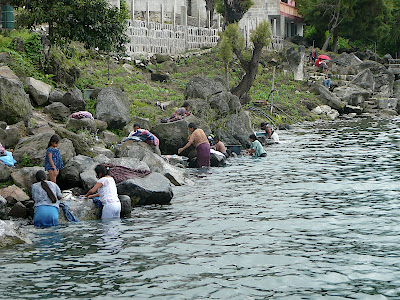
The shore was filled with children swimming, men fishing, several people washing away the dirt of the fields with bars of Irish Springs, and half-a-dozen local mujeres standing waste high in the water doing the morning laundry. Roughly 15 stone washboards were somehow secured in the water for this purpose, and it was quite an experience to pretend for a moment that our presence was not an intrusion but rather a window into a culture whose daily lives have revolved around this lake for as many years as the lake is meters high. The only reminder of the time in which we now live was to the see the Doritos bags and Coke bottles rattling against the rocky shore.
In short, Atitlan is a beautiful place, ruined only by the tourists (just like us :) that pollute the water and the local culture with their presence. It is easy to forget that the presence of tourism, while corrupting an ancient way of life, brings many positive side-effects, it being the main source of income in the region.
Reconciling the tradeoff between cultural and environmental preservation with finding opportunities for development in the face of abject poverty is an issue that has given us much to ponder. While the road to hell may be paved with good intentions, it seems plausible that an educated, cautious optimism and a humble approach can lead to those same good intentions leading to more desirable outcomes. What remains to be seen is how far the aforementioned tradeoff reaches, and what sacrifices must be made to achieve that greater purpose. As with most things in life, tradeoffs are unavoidable and any action results in both positive and negative side-effects. Although--not to downplay the severity of the irretrievable losses that change brings with it--a negative result does not imply a balance cannot be found, or that one should stop trying to find it, as life and development is about striving to find that elusive equilibrium which does more good than harm...(can you tell I'm an Economics student yet? :)
Estoy Pensando,
Justin